
A child who feels known is more likely to raise a hand, try a new activity, and recover from a hard moment. That is why the decision about private school versus public is about far more than a building, a schedule, or a school name. For families choosing preschool through second grade, it is a decision about where a child will begin to see themselves as a learner.
Both private and public schools can offer meaningful, caring educational experiences. The better fit depends on your child, your family’s needs, and the particular schools available to you. Looking beyond broad assumptions can help you make a choice with both confidence and heart.
Private School Versus Public: Start With Your Child
At ages 3 through 8, children are developing foundational academic skills while also learning how to join a group, communicate needs, manage feelings, and trust their own growing abilities. A school setting should support all of those areas.
Some children thrive in a larger, energetic environment with many peers and activities happening around them. Others feel more comfortable when routines are familiar, classrooms are smaller, and teachers have more opportunities to notice subtle changes in confidence or behavior. Neither response is right or wrong. It is simply useful information about what helps your child feel secure enough to learn.
When visiting a school, picture an ordinary Tuesday rather than an idealized school day. Ask yourself: Would my child be comfortable entering this classroom? Who would notice if they were unusually quiet? How are children supported when they are frustrated, eager for more challenge, or still learning to separate at drop-off?
The answers often matter more than a school’s reputation alone.
Class Size and Individual Attention
Class size is one of the clearest differences families may encounter. Public schools can vary widely by district, grade level, and available resources. Many have dedicated educators doing excellent work in full classrooms, often with access to broad programs and support services. Yet larger groups can make individualized attention more difficult, especially during the early years when children progress at very different rates.
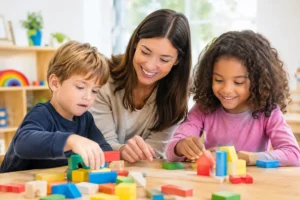
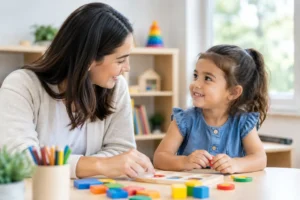
Private schools often have smaller class sizes, which can create more daily opportunities for teachers to know each child as an individual. A teacher may be better positioned to recognize that one student is ready to stretch beyond beginning reading skills, while another needs extra time to build pencil control or confidence during group discussions.
Individual attention is not about pushing young children ahead too quickly. It is about meeting them where they are. In a nurturing early childhood or lower elementary classroom, a child can receive support without feeling singled out and enrichment without feeling pressured.
For parents, the important question is not simply, “How many students are in the class?” Ask how teachers use their time. Do they observe children closely? Are learning activities adapted when needed? Is there room for a child’s personality, interests, and pace to be part of the learning plan?
Curriculum: Structure With Room to Grow
Families sometimes assume public schools are more academic and private schools are more flexible, or the reverse. In practice, quality curriculum depends on the school itself.
A strong early learning program gives children structure and clear academic foundations. They need purposeful opportunities to build early literacy, number sense, writing readiness, listening skills, and problem-solving. They also need hands-on exploration, creative expression, movement, play, and meaningful conversation. These are not extras. They are central to how young children learn.
Public schools typically follow district and state standards, which can offer consistency and a clear progression from grade to grade. Private schools may have more flexibility in how they organize curriculum and classroom experiences. That flexibility can be especially valuable when it allows educators to respond to a class’s interests or provide extra practice in a developmentally appropriate way.
The best question is not whether a school uses worksheets, centers, projects, or phonics instruction. Ask how those elements work together. Is academic learning thoughtful and age-appropriate? Do children have opportunities to explore and create? Are teachers helping students understand ideas, not just memorize answers?
A balanced program prepares children for future school success while protecting the joy and curiosity that make them want to keep learning.
Teacher Experience and Continuity
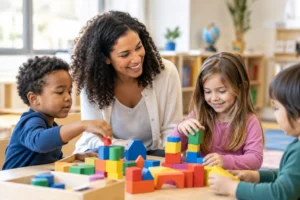
Young children build confidence through relationships. The teacher who learns how a child likes to be greeted in the morning, notices a new friendship forming, or gently encourages them to share an idea is doing work that reaches well beyond one lesson.
Public and private schools both employ committed teachers, but staffing structures may differ. In any setting, families should ask about teacher qualifications, professional development, classroom support, and staff continuity. Experienced educators bring a deep understanding of child development, but long-tenured teachers can also bring something especially reassuring: stability.
When a school has teachers who have been part of its community for years, they often know what children need at each stage and understand the concerns families bring during transitions. They have seen many children move from hesitant preschoolers to confident elementary students. That perspective can help parents feel supported, particularly when their child is entering school for the first time.
At The Winchester School, longstanding teachers and a close-knit community are part of the daily experience. For a young child, seeing familiar, caring adults each day can turn school from a place they attend into a place where they belong.
Communication Is Part of the Educational Experience
A child’s learning does not begin at the classroom door and end at dismissal. Families and teachers both hold important pieces of the picture. Parents know their child’s routines, worries, strengths, and changing interests. Teachers see how that child approaches learning and relationships in a group.
In public schools, communication practices can differ from classroom to classroom and may be shaped by the demands on teachers’ time. Private schools may be able to offer more direct or frequent family communication, though parents should always ask what that looks like in practice.
Look for a school that treats questions as welcome. You should understand how teachers share progress, how concerns are addressed, and how parents can participate in the school community. Clear communication is especially valuable during early childhood, when a small change in sleep, behavior, or confidence can affect a child’s day.
A healthy school-family partnership does not mean parents need constant updates. It means families know their child is seen, and they have a trusted path for conversation when it matters.
Resources, Services, and Daily Logistics
Public schools may offer services and resources that are difficult for a smaller school to match, including specialized programs, transportation, larger facilities, and a wide range of extracurricular activities. For some families, these offerings are a deciding factor. Public education is also tuition-free, an essential consideration for many households.
Private schools are tuition-based, so affordability deserves an honest and practical conversation. Families should consider not only tuition, but also schedules, transportation, before- and after-school needs, meals, enrichment, and summer options. A school can be a wonderful fit educationally, but it must also work sustainably for the family.
At the same time, smaller schools may provide advantages that feel significant in the early years: a more intimate community, consistent routines, direct access to teachers and administrators, and a setting designed specifically around younger children. Some families value a school where their child is not one face in a very large student body.
If your child needs specialized services, ask specific questions before enrolling. How are learning differences identified? What support is available within the classroom? How does the school partner with outside professionals when appropriate? A thoughtful school will answer clearly and without making promises it cannot keep.
Visit With a Parent’s Eye, Not a Brochure’s Eye
Every school can describe its mission beautifully. A visit helps you understand how that mission feels in real life.
Pay attention to the children. Are they engaged, comfortable, and treated with respect? Notice how adults speak to them during transitions, conflicts, and moments of uncertainty. Look for classrooms where children’s work is valued, materials are accessible, and routines seem calm without being rigid.
Listen for warmth as well as academic language. Young children need expectations and guidance, but they also need room to be children. The strongest early learning environments pair purposeful teaching with patience, laughter, and genuine care.
There may not be one universally better choice between private and public school. There is, however, a school environment that can be better for your child right now. Trust the questions that stay with you after a tour, and choose the place where your child’s growing confidence feels not only possible, but protected.